Search "Corrales home prices" this week and you'll get answers that contradict each other depending on which site you land on. One home value index put the average Corrales home at $703,332 as of late May 2026, up three percent from a year earlier. A different portal's August 2026 data shows a median list price of $899,000, even as the price per square foot across the village fell six percent year over year, with the site describing the local market as slowing down. Same village, roughly the same stretch of 2026, and the two readings point in opposite directions.
Neither site is wrong, exactly. They're both measuring a market that doesn't behave like the rest of the metro, and the reason has less to do with buyer demand than with what sits underneath every lot in the village.
A village with no water main and no sewer line
Corrales has no municipal water system. Every home and business in the village runs on a private well. There's no sewer system either, apart from a small stretch along Corrales Road between Alameda Boulevard and Wagner Lane that connects to a septic effluent pump system routed to the Albuquerque-Bernalillo County Water Utility Authority. Outside that strip, and it's a small one, you're on well and septic, full stop.
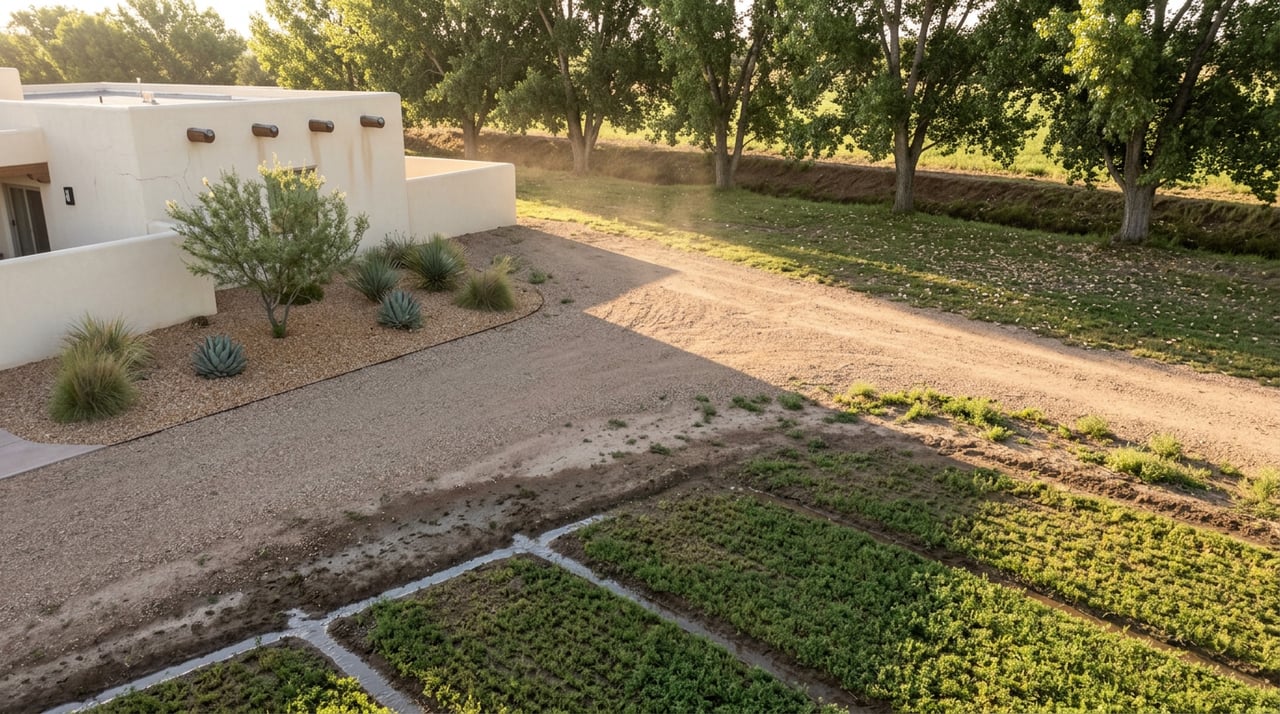
That single fact explains a lot about the price swings. In most Albuquerque-area neighborhoods, the utility connection is a fixed cost baked into the lot and largely invisible in the sale price. In Corrales, the well, the septic system, and the water rights attached to the parcel are the sale price, or at least a meaningful and highly variable slice of it. A one-acre lot with a modern well, a working septic system, and irrigation rights through the historic Corrales acequias is a different asset than a similarly sized lot with an aging well and no documented water rights, even if the houses on both are the same square footage. Portals that average across a small number of closings each month are going to produce noisy numbers when the underlying inventory varies this much lot to lot.
The village just admitted its own water math doesn't add up yet
This is where the story stops being about listing prices and starts being about the village itself. On August 18, 2026, the Corrales Village Council unanimously approved a 40-year water development plan, a document the state engineer's office requires and one the village had never formally completed before. The plan lays out how Corrales intends to manage a water supply that's already stretched.
The numbers behind that vote are stark. New Mexico is close to breaking the Rio Grande Compact with Texas, and one village official put it plainly during the planning discussion: "We're sitting at 132,000 acre-feet of debt to Texas. The debt ceiling is 200,000 acre feet." Corrales itself has been over-diverting from its own wells and is currently leasing 30 acre-feet a year from the town of Bernalillo to cover the gap, an arrangement that expires in 2030 and won't be renewed. To fill that hole, the village is pursuing roughly 50 additional acre-feet of water rights and has lined up a $2 million line of credit from the New Mexico Environment Department to help pay for the purchase, a process that takes at least a year even without a protest and up to five if someone contests it.
None of this changes what's in your septic tank tomorrow. It does change how seriously a buyer should take the question of water rights on any specific parcel, because the village that governs those rights is currently negotiating for its own water future and has said so publicly.
What that means once you're standing on the property
New Mexico follows a use-it-or-lose-it doctrine for water rights, and the older a right, the more legal priority it carries under the state's prior appropriation system. Whether a given right transfers with a deed isn't automatic. Corrales itself tells buyers, through its own water guidance, to confirm this with the Office of the State Engineer or a private water rights professional before assuming anything, since irrigation rights are generally considered appurtenant to the land but domestic well permits work differently.
A few specifics worth knowing before you write an offer on Corrales acreage:
- The village allows only one dwelling unit per acre, a rule adopted specifically to keep enough separation between private wells and septic systems to protect drinking water.
- Wells must sit at least 50 feet from any septic tank and 100 feet from any drain field or seepage pit.
- Lots smaller than three-quarters of an acre that can't connect to sewer are required to use an advanced septic treatment system rather than a conventional one, which changes both installation cost and ongoing maintenance.
- A New Mexico Environment Department study found nitrate levels in some Corrales wells reaching up to 6.5 milligrams per liter, still under the federal limit of 10 but several times the natural background level for the area, a reminder that annual well testing isn't optional housekeeping here.
You can look up well permits, point-of-diversion records, and water right filings directly through the state engineer's public water rights reporting system, which is worth doing before you fall in love with a barn.
The actual math under the median
Septic service in Corrales typically runs between $1,382 and $2,020, with a wider range up to $4,265 depending on system type and site conditions, and routine pumping averages around $380. Those numbers sound small next to a $700,000 to $900,000 home. They stop sounding small the moment a system needs replacement rather than pumping, especially on a sub-acre lot that's now required to install the advanced treatment version rather than a conventional tank and field.
This is the piece the median price can't show you. Two homes in Corrales can carry nearly identical list prices and represent very different actual costs of ownership, because one sits on a lot with a well drilled in the last decade and documented acequia irrigation rights, and the other has a well of unknown age, no clear water rights paperwork, and a septic system nobody has inspected in years. The portals average the sale prices. They don't average the due diligence.
What this means if you're comparing Corrales to somewhere else
If you're cross-shopping Corrales against a neighborhood with municipal water and sewer, the median price comparison you're running in your head is comparing two different kinds of transactions. In a municipal-utility market, the price mostly reflects the structure and the land. In Corrales, you're also pricing a private water system and a set of legal rights that the village itself is currently working to secure more of. That's not a reason to avoid the village. It's a reason to budget time and money for verification that a suburban purchase wouldn't require, and to work with someone who treats the well report and the water rights history with the same weight as the home inspection.
A few common questions
Does a Corrales property's water rights automatically transfer when I buy the home? Not necessarily. Irrigation rights are generally considered legally attached to the land and typically transfer with the deed. Domestic well rights and how they're documented can be more complicated, which is why the village recommends confirming details with the Office of the State Engineer or a private water rights professional before closing.
Why do some Corrales properties need an advanced septic system instead of a standard one? Lots under three-quarters of an acre that can't tie into the small sewer-connected stretch along Corrales Road are required to use an advanced treatment system rather than conventional septic, a rule tied to the same water-protection goals behind the one-dwelling-per-acre zoning.
Should I get my well tested even if the seller says the water is fine? Yes. Given documented nitrate findings in some village wells and the fact that private wells aren't subject to the same oversight as a municipal system, an independent test before closing is standard due diligence here, not an extra step.
Corrales rewards patience and punishes assumptions, especially the assumption that a listing price tells you everything you need to know about what's underground. If you're weighing a property here against something in a metro neighborhood with city water, Momentum Real Estate Group can walk the specific parcel with you, from the well report to the water rights history, before you're the one holding the surprise. Get your free home valuation and let's talk through what a Corrales number actually includes.
